Conclusion
It literally means decorating a function; you can think of it as the concept of composite functions that we learned in mathematics. Awesome explanation 1 Awesome explanation 2
Decorators are used to implement additional functionality without modifying existing functions.
Decorator = trace function Existing function = hello, world function
def trace(func):                             # 호출할 함수를 매개변수로 받음
    def wrapper():                           # 호출할 함수를 감싸는 함수
        print(func.__name__, '함수 시작')    # __name__으로 함수 이름 출력
        func()                               # 매개변수로 받은 함수를 호출
        print(func.__name__, '함수 끝')
    return wrapper                           # wrapper 함수 반환

def hello():
    print('hello')

def world():
    print('world')

trace_hello = trace(hello)    # 데코레이터에 호출할 함수를 넣음
trace_hello()                 # 반환된 함수를 호출
trace_world = trace(world)    # 데코레이터에 호출할 함수를 넣음
trace_world()
Cases where @ is used
def trace(func):                             # 호출할 함수를 매개변수로 받음
    def wrapper():
        print(func.__name__, '함수 시작')    # __name__으로 함수 이름 출력
        func()                               # 매개변수로 받은 함수를 호출
        print(func.__name__, '함수 끝')
    return wrapper                           # wrapper 함수 반환

@trace    # @데코레이터
def hello():
    print('hello')

@trace    # @데코레이터
def world():
    print('world')

hello()    # 함수를 그대로 호출
world()    # 함수를 그대로 호출
Principle
A decorator takes the form of wrapping a function.
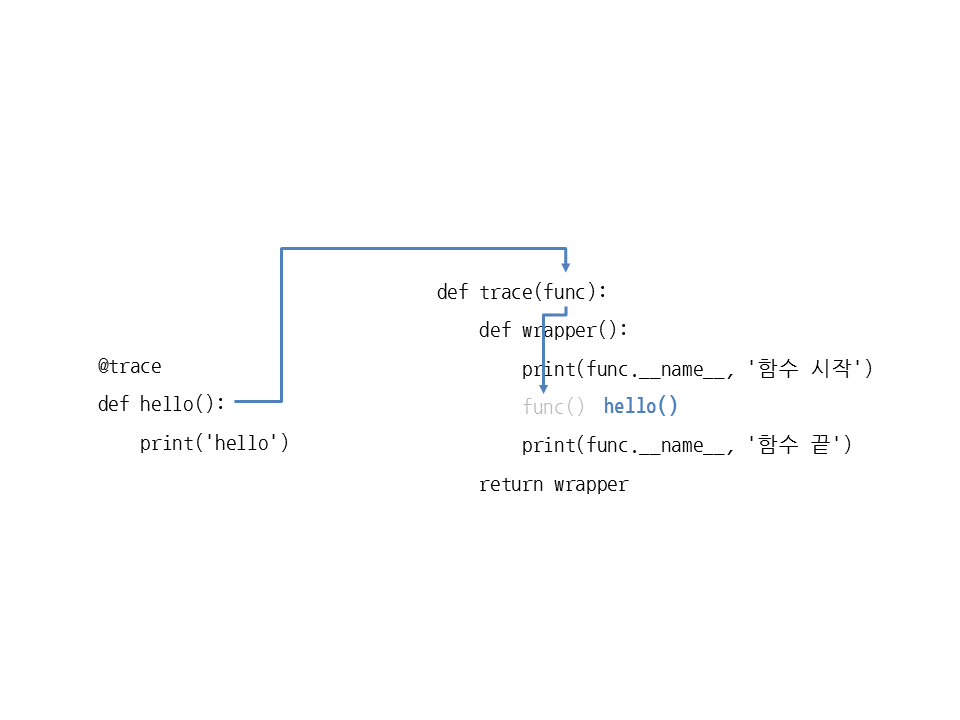
Note -> You can also specify multiple decorators.
@데코레이터1
@데코레이터2
def 함수이름():
    코드
References https://dojang.io/mod/page/view.php?id=2427