What is Bayes’ Theorem?
Bayes’ theorem is a law of probability used to infer the cause after an event has occurred.
In other words, it provides a way to update the probability of another event occurring based on an event that has already occurred.
1. Formula for Bayes’ Theorem
Bayes’ theorem is expressed as follows using conditional probability:
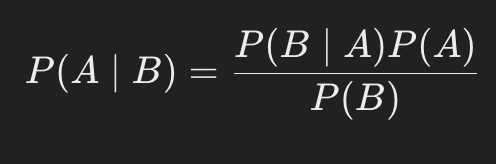
- P(A | B): The probability that A occurred after B occurred (Posterior Probability)
- P(B | A): The probability that B occurs given that A has occurred (Likelihood)
- P(A): The probability that A occurs (Prior Probability)
- P(B): The probability that B occurs (the probability that B occurs among all possible cases)
2. Why Is Bayes’ Theorem Important?
Bayes’ theorem is the process of updating probabilities when new information is provided.
In other words, it calculates the posterior probability by modifying the existing probability (prior probability) using new information (likelihood).
- Medical diagnosis: Update the probability of having a disease based on test results
- Machine learning: The process by which a model updates probabilities when new data is provided
- Criminal investigation: Calculate the probability that a suspect is the perpetrator based on the given evidence
3. Example: Disease Diagnosis
Suppose that the probability of having a certain disease (e.g., influenza) is 1%.
The probability of receiving a positive result on a test for this disease is as follows:

Here:

We need to find the probability that a person actually has the disease when the test result is positive, P(D | T^+).
Applying Bayes’ Theorem
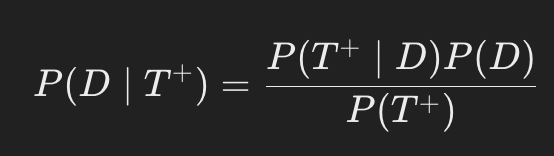
First, we need to find P(T^+). The overall probability of receiving a positive test result is calculated as follows:

Substituting the values:

Now, use Bayes’ theorem to find P(D | T^+):

In other words, even if the test result is positive, the probability that the person actually has the disease is only about 16.1%.
(This is why you should not rely solely on the test result!)
4. Extension: Multiple Causes (Using the Law of Total Probability)
Bayes’ theorem can also be used when there are multiple causes rather than a single cause (A).
If B occurred due to one of several possible causes A_1, A_2, …, A_n:

This is called the Law of Total Probability.
5. Conclusion
-
Bayes’ theorem is a method for updating probabilities when new information is provided.
-
You can infer causes by using conditional probability.
-
It is widely used in medicine, artificial intelligence, finance, criminal investigation, and other fields.
-
Basic formula:

-
Application example: A problem of finding the actual probability of disease when the test result is positive
If you have any further questions, please feel free to ask! 😊